
[Health Digest = Reporter Choi Min-young] While the nationwide COVID-19 outbreak stemming from the Itaewon club outbreak has once again raised concerns, statistics indicate that the likelihood of further spread has significantly decreased. However, the Korea Centers for Disease Control and Prevention (KCDC) and experts have stated that the end of COVID-19 remains uncertain, and a second wave of the pandemic in the fall is a concern.
Biotechnology companies both domestically and internationally are focused on developing vaccines and antibodies, but they predict it will take months, if not more than a year, for treatments to become widely available.
COVID-19 has thrown the world into a state of unpredictable turmoil, and it continues to unfold. Even as treatments are being developed, we cannot afford to let our guard down.
Therefore, preserving and strengthening our immune systems until the pandemic is over is crucial. Reports of cases of COVID-19 patients being treated with stem cells, a cutting-edge cell type, are fueling growing interest in stem cells.
On March 18th, the British daily Daily Mail reported that a joint study by the American stem cell company BHI and Dr. Wu Dongcheng of Wuhan, China, successfully treated nine elderly patients with severe COVID-19 by administering intravenous stem cell injections.
Furthermore, on March 2nd, the Hong Kong-based South China Morning Post (SCMP) reported that a research team led by Professor Hu Min of Kunming University in Yunnan Province, China, published a paper reporting that a 65-year-old woman with severe COVID-19 in China tested negative for the virus and showed improvement after receiving stem cell treatment.
In response, Miracell Bio Research Institute (CEO Shin Hyun-soon), a stem cell specialist company, stated, “Based on the latest research findings, stem cells extracted from a patient’s own bone marrow or blood have the ability to reduce inflammation and find, regenerate, and repair damaged tissue.”
“Stem cells can help suppress excessive inflammatory responses by activating tissue regeneration through communication with immune cells in damaged areas of the body and also controlling inflammatory responses,” he explained.
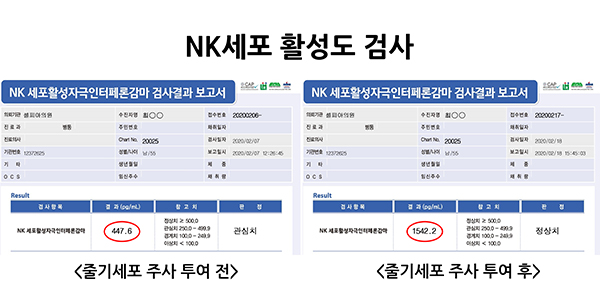
The medical team at Cellpia, a domestic stem cell specialty clinic, stated, “The human body possesses natural killer (NK) cells, innate immune cells that can kill viruses and abnormal cells that invade the body without antibodies. NK cell activity is crucial for survival against COVID-19.”
“Given the cases of increased NK cell activity following intravenous stem cell administration, it can be said that stem cells play a crucial role in treating viral diseases and enhancing our immune system.”
While large-scale clinical trials of stem cell therapy have not yet been reported, active research is underway both domestically and internationally, as it is being applied to treat intractable and degenerative diseases.
Reporter Choi Min-young kunkang1983@naver.com
Original article link: http://www.ikunkang.com/news/articleView.html?idxno=31410