
[Hankyung Health] 2019-05-20
“7 Trillion Won if Global New Drug Launches”… K-Bio Strikes Gold in Osong
Escape the Crisis! Bio is Hope
(1) K-Bio: Kicking Off the Frontier
Osong, North Chungcheong Province, is growing into Korea’s largest bio manufacturing base, seven times the size of Pangyo Techno Valley, Gyeonggi Province. As the biomedical device ecosystem develops, more and more pharmaceutical and biotech companies are establishing bases here.
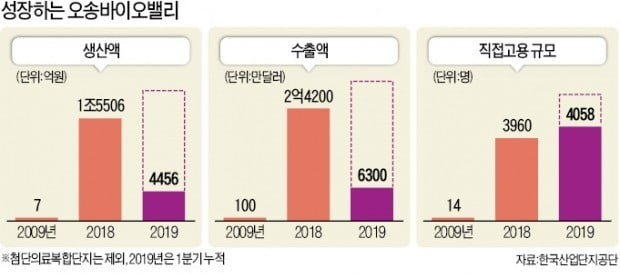
According to the Korea Industrial Complex Corporation (KICOX) on the 19th, Osong Bio Valley’s production, which stood at a mere 700 million won in 2009, surged to 1.55 trillion won last year. Production in the first quarter of this year reached 445.6 billion won, and when including the advanced medical complex, which is not included in the statistics, total production is projected to approach 2 trillion won this year. Employment also increased from 14 to 4,058 over the same period.
In just ten years since cosmetics company Piontech opened its first factory in Osong Bio Valley in October 2009, Osong has transformed into Korea’s largest bio cluster. Over 200 pharmaceutical and biotech companies have moved into the area. These include pharmaceutical and biotech companies such as LG Chem, Daewoong Pharmaceutical, and Meta Biomed, as well as government agencies such as the Ministry of Food and Drug Safety and the Korea Centers for Disease Control and Prevention, universities such as Chungbuk National University, and hospitals such as Bestian Hospital.
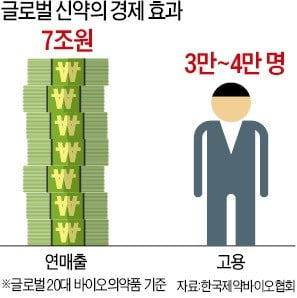
Chong Kun Dang Bio and CJ Healthcare are planning to build factories in Osong. This is to foster the high-value-added biohealth industry as a future growth engine. The economic impact of global new drugs is enormous. Humira, a rheumatology treatment developed by AbbVie in the US, generates annual sales of 22 trillion won, comparable to the size of the entire domestic pharmaceutical industry (20 trillion won). Won Hee-mok, Chairman of the Korea Pharmaceutical and Bio-Pharma Manufacturers Association, stated, “Developing a single drug with annual sales of 7 trillion won creates 40,000 jobs.”
Osong, a bio-mecca, has become a hub for K-bio. CJ Healthcare and Chong Kun Dang are building new factories one after another.
LG Chem’s new diabetes drug Zemiglo, CJ Healthcare’s 30th domestically developed new drug K-Cab, and Medytox’s Medytoxin, Korea’s top-selling botulinum toxin. These products are all produced at the Osong Bio-Science Complex in North Chungcheong Province and exported globally. Since the first company moved in in 2009, Osong Bio Valley has grown into Korea’s largest bio cluster in just 10 years. Production, exports, and jobs have also increased significantly, leading to its recognition as a beacon of hope for K-bio.
While Incheon’s Songdo Bio Valley is growing as a bio-valley led by Celltrion and Samsung BioLogics, centered around biosimilars (generic biopharmaceuticals), Osong is establishing itself as a mecca for public-private bio-manufacturing. The domestic pharmaceutical and bio-industry accounts for only 1.7% of the global market, still remaining a marginal player. However, with the increasing number of products entering the global market, centered around Osong Songdo and other bio-valleys, analysts predict a bright future for the domestic bio-health industry.
Pharmaceutical and bio companies expanding their Osong plants
According to pharmaceutical and bio industry sources on the 19th, CJ Healthcare has established plans to expand its Osong plant, aiming for production in 2021. CJ Healthcare currently operates a 25,663㎡ plant in Osong. K-Cab, a new drug for treating gastroesophageal reflux disease produced there, has been exported to countries such as China, Vietnam, and Mexico. A company representative stated, “With the expansion, we will be able to create an additional 80 to 100 jobs.”
Meditox also previously announced plans to invest 47.6 billion won by August next year to build a new plant in Osong to produce botulinum toxin products. Chong Kun Dang Bio plans to invest 45.7 billion won and open its new plant in December 2021.
Smaller biotech companies are also establishing bases in Osong. Emgen Plus Miracell and others signed a contract to move into Osong Bio Valley. Ajinomoto Genexine, a Japanese company operating a domestic subsidiary in Songdo, will open a new office in Osong next month. Yaron Silverberg, Chief Scientific Officer at Ajinomoto Genexine, said, “Opening an office in Osong, a city with a concentration of pharmaceutical and cosmetics companies, will allow us to expand our collaborations.”
Many companies operating in Osong are leading global markets. Meta Biomed, which operates a plant in Osong, is the world’s leading manufacturer of dental fillings. Its products account for 20% of the global dental fillings market.
The creation of a private bio-ecosystem is also in full swing.
The Osong Bioscience Complex project began in 1997. Osong’s transformation began in 2010 with the arrival of national institutions like the Ministry of Food and Drug Safety and the Korea Health Industry Development Institute. The 4.63 million square meter first complex, including the advanced medical complex, has been fully sold out. The 3.29 million square meter second complex, which began sales in 2016, has also been fully sold out, excluding the foreign investment zone. This is a year ahead of the original plan. North Chungcheong Province is currently pursuing the development of a third complex, targeting completion by 2026. The land area alone will reach 8.47 million square meters. Once completed, Osong Bio Valley will expand to 16.39 million square meters, a world-class scale. This scalability is driving the increase in biohealth companies seeking to move to Osong. Access to regulatory agencies like the Ministry of Food and Drug Safety and national research facilities like the National Biobank are also considered advantages.
As more companies enter the Osong area, a self-sustaining ecosystem is forming. The Innovative New Drug Salon, previously operating in Daejeon and Pangyo, Gyeonggi Province, began meeting in Osong late last year. Bestian Hospital, which opened a 100-bed clinical trial center there last year, spearheaded the initiative. This private networking group brings together researchers in the biotechnology field. The Cosmetics Research Association, a gathering of cosmetics companies, also held its first meeting in March of this year. Osong-based diagnostic device companies, including Sugentech, plan to launch a new diagnostic device company meeting this year.
Yang Jae-hyeok, Director of External Cooperation at Bestian Hospital, said, “Genentech, the world’s leading biotechnology company with annual sales of 20 trillion won, was born from a beer hall gathering of engineers and investors. Collaboration is expanding in Osong as voluntary public-private exchange groups are increasing.” He added, “The biotechnology industry is experiencing a trend of specialized companies emerging at every stage, from preclinical trials to Phase 3 clinical trials and product development. This is why clusters that bring together diverse industries are becoming increasingly important.”
Still limitations due to lack of manpower and regulations
Osong, at the center of change, also faces limitations. Recruiting talent is a prime example. This is a major challenge for domestic biotech companies. A representative from a company in the Osong complex stated, “With the nearby highway and the opening of the high-speed rail line, accessibility to Seoul is excellent, but access to nearby areas like Cheongju is limited.” He added, “Accessibility to Cheongju, with its large population, needs to be improved.”
Efforts are also needed to designate specific business areas that can only be operated in Osong and to deregulate them. Some argue that to develop Osong into a world-class bio valley, it should be designated as a regulatory special zone and utilized as a platform to demonstrate diverse biohealth industries. An industry insider stated, “While various special provisions apply to companies in Osong, the benefits are limited due to varying interpretations by different ministries and local governments. The Bioethics Act and the Medical Services Act should be specifically applied to Osong to allow for medical data research.”
Osong = Reporter Lee Ji-hyeon bluesky@hankyung.com